
Augur
Industry
AI powered security
Product
SaaS Platform
Overview
I joined Augur as the founding product designer, responsible for transforming an early-stage AI proof of concept into a scalable SaaS platform.
Augur applies artificial intelligence to existing CCTV infrastructure, enabling automated detection of people, events, and behavioural patterns—shifting security from reactive monitoring to proactive insight.
My role
Founding Product Designer
Scope
Product strategy, UX/UI design, design system
Stage
Early-stage startup (pre-seed → seed)
Outcome
Investor-ready product contributing to $15M seed funding
The problem
Traditional CCTV systems are fundamentally limited:
- They rely on humans to monitor and interpret footage
- Investigations require hours of manual video review
- Insights are lost when footage is deleted
- Systems are reactive, not preventative
The result: Security teams spend more time reviewing the past than preventing the future.

The opportunity
Augur’s technology could:
- Detect people, behaviours, and patterns automatically
- Surface real-time alerts and insights
- Turn static footage into searchable, queryable data
The challenge was designing a product that could make complex AI outputs usable, intuitive, and actionable.

My role
As the founding designer, I:
- Defined the product vision and UX strategy
- Translated a technical prototype into a usable SaaS platform
- Led discovery, concept exploration, and interaction design
- Worked closely with the founder and engineers
- Built the foundations of a scalable design system
Discovery & Alignment
Step 1: Rapid response
In my first week, I delivered design work to support a live client presentation, quickly getting up to speed with the product and domain.
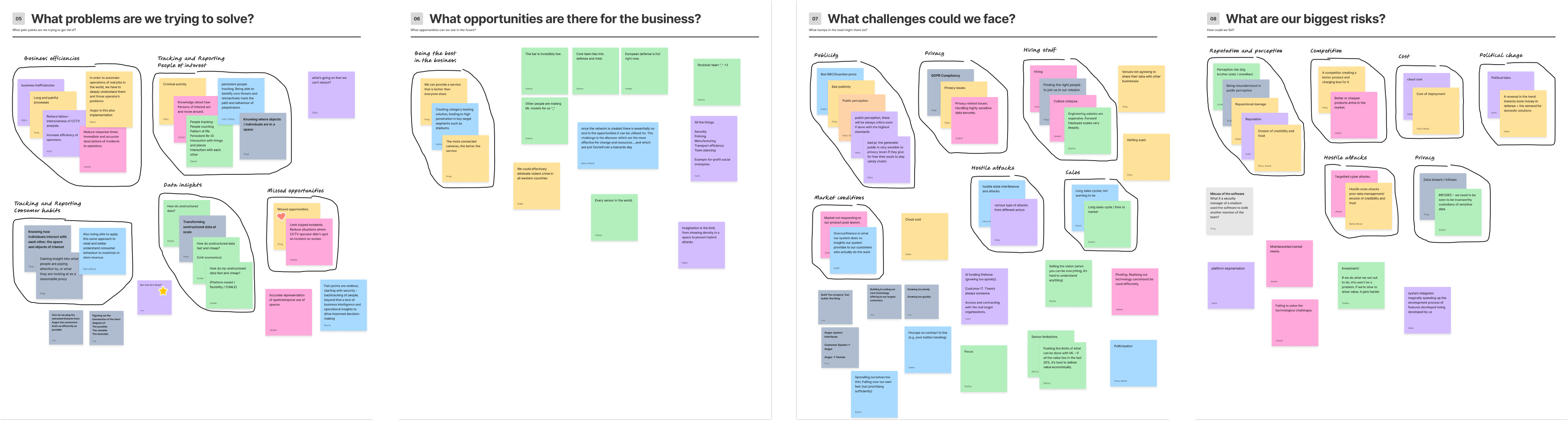
- Step 2: Defining the problem space
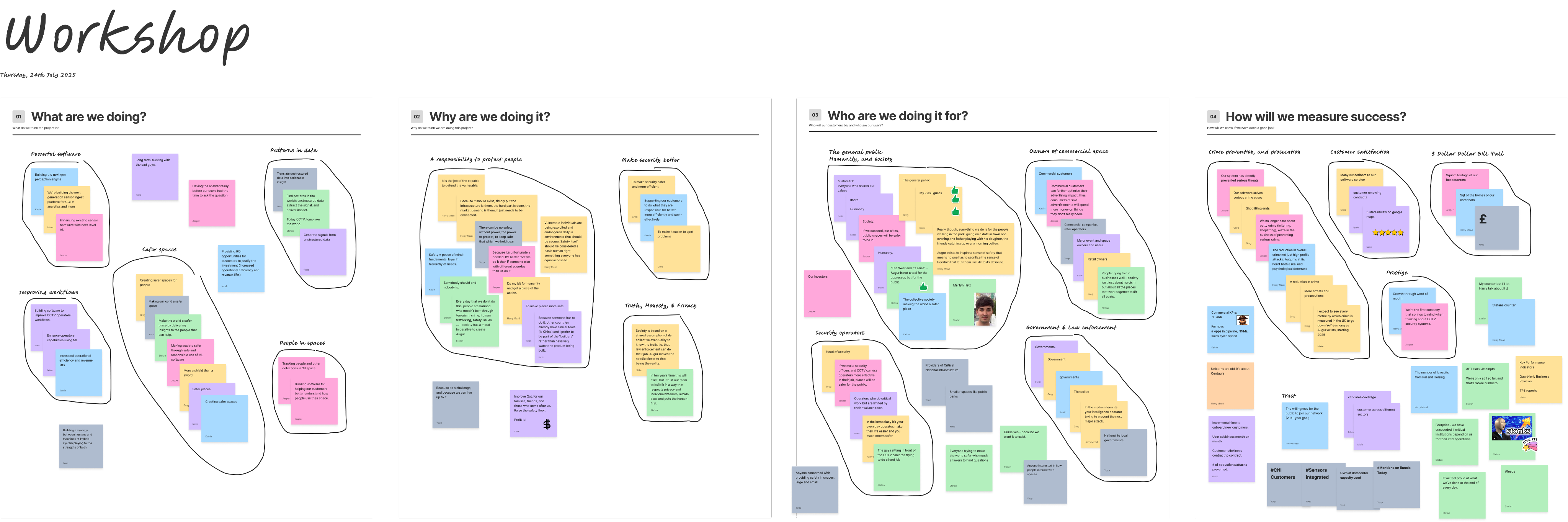
- I facilitated a cross-functional workshop to align the team on:
- What we’re building and why
- Who it’s for
- What success looks like
- Risks, constraints, and opportunities
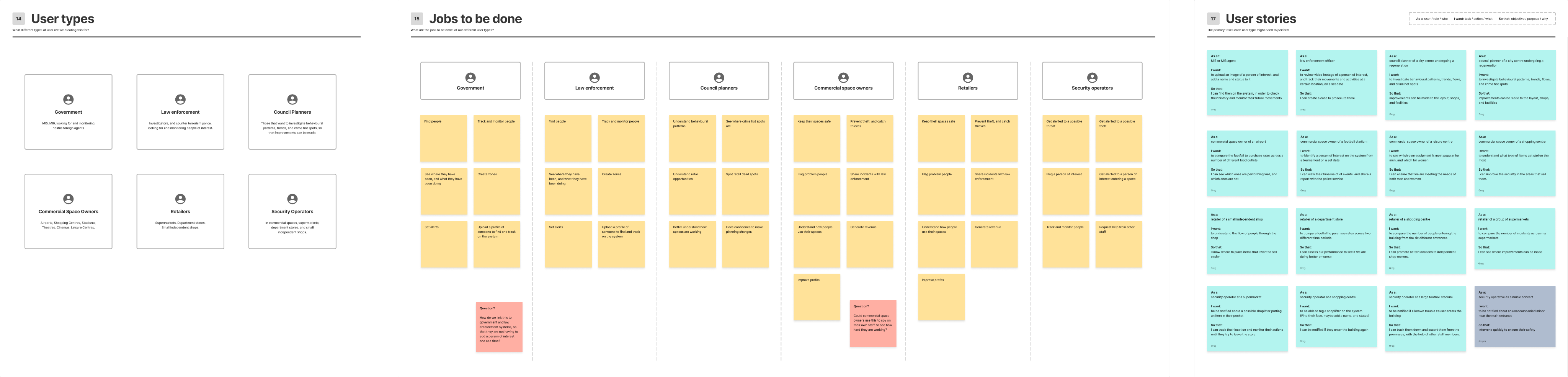
- We mapped:
- User types (security operators, analysts, business owners)
- Jobs to be done
- Potential applications across industries
Shaping the product
Insights from discovery were translated into:
- User stories
- End-to-end journeys
- Core interaction flows
This helped define a product focused on three key activities:
- Monitoring (what’s happening now?)
- Investigation (what happened?)
- Analysis (what patterns exist?)
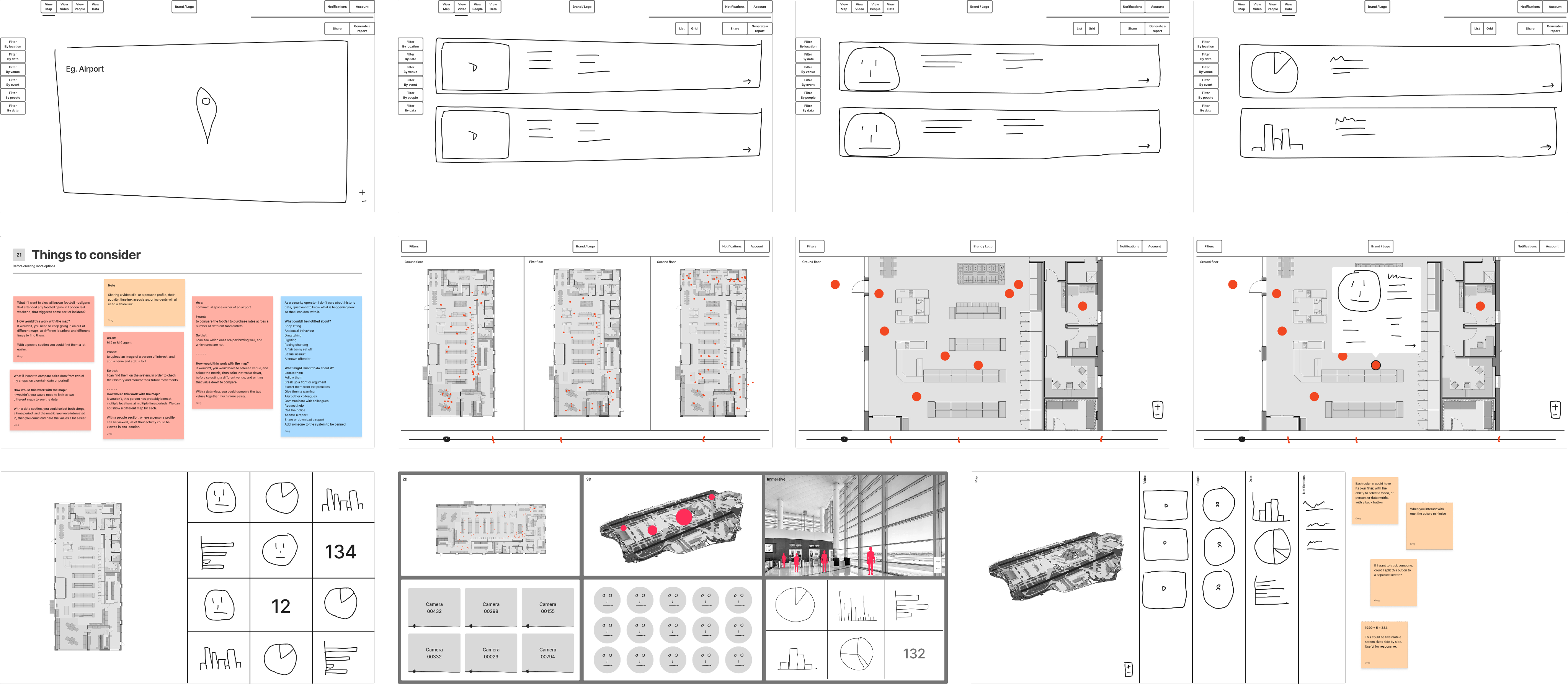
Design exploration
I explored 7 different product directions, each tackling how users might:
- Navigate physical spaces
- Interact with time
- Understand AI-detected events
- Move between data and video
We reviewed concepts collaboratively, assessing trade-offs between:
- Simplicity vs capability
- Spatial vs list-based interfaces
- Real-time vs historical interaction models
Designing the core experience
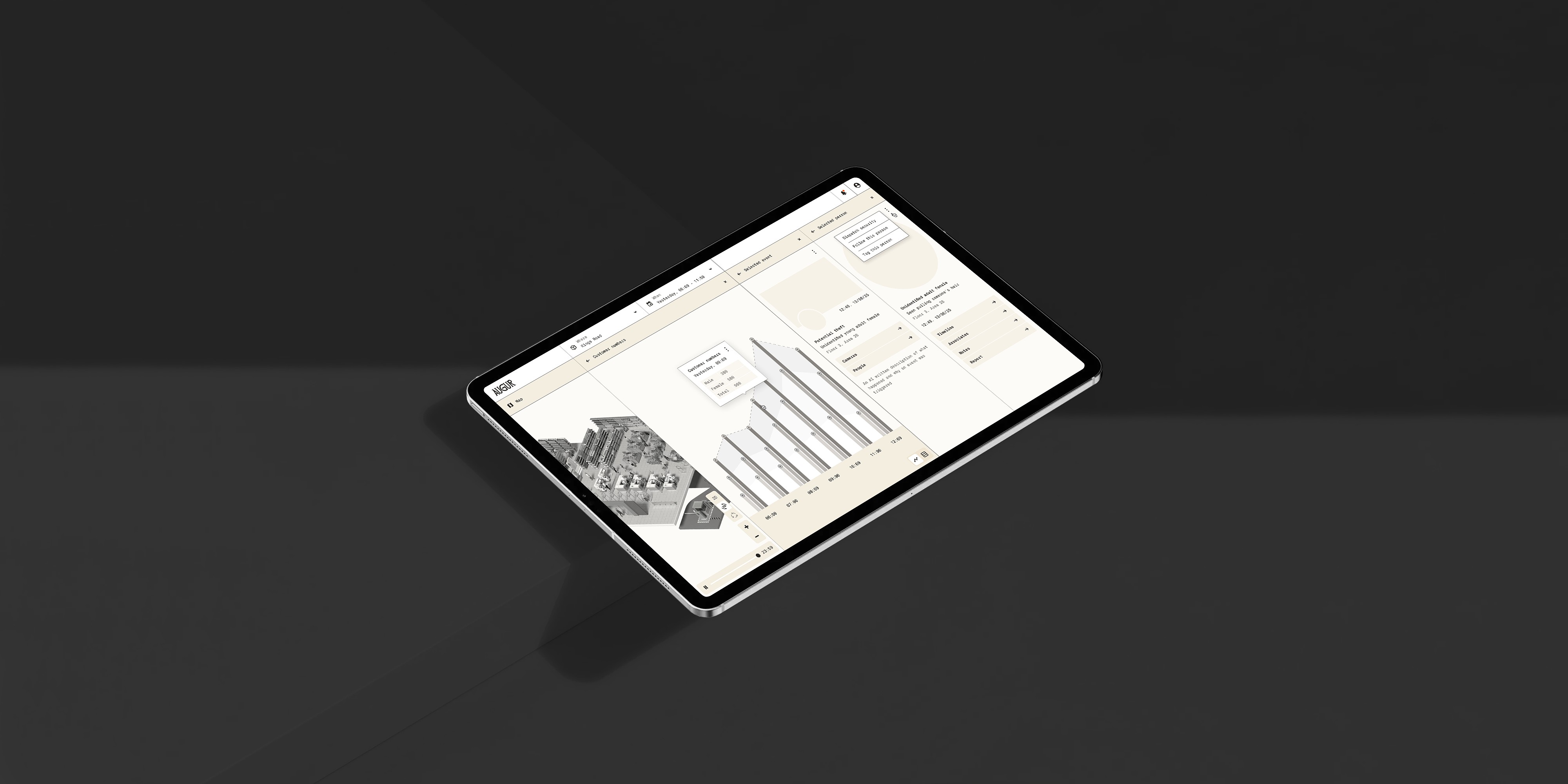
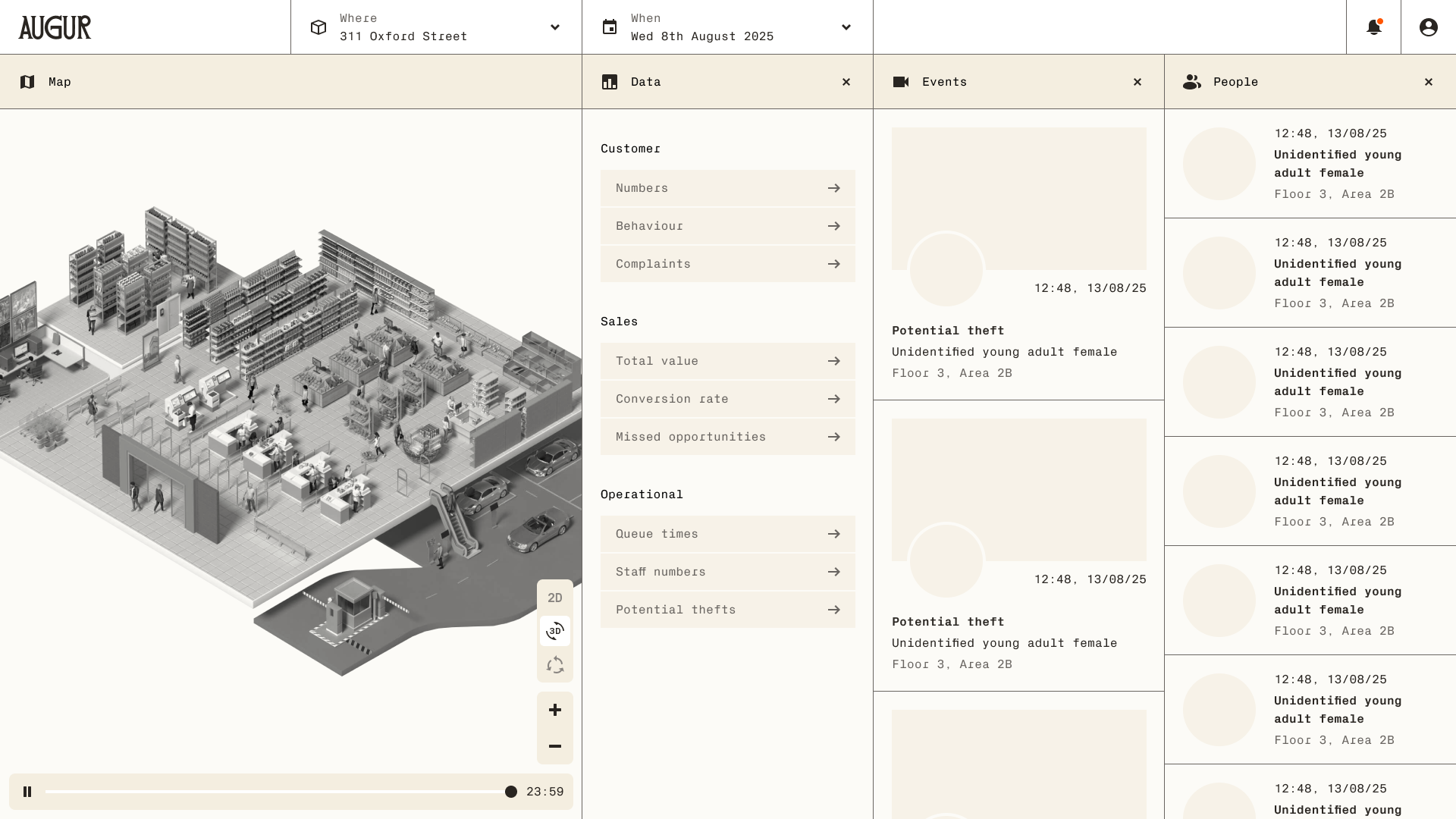
The final product centred around a spatial + temporal interface, allowing users to explore environments across time.
Space navigation

Kings Road
Where
Select and move through physical environments
Time control


Yesterday morning
When
Scrub backward and forward through events
Entity tracking
12:48
Unidentified young female
Floor 3
Identify and follow individuals across a space
Event detection
12:48
Potential theft
Unidentified young female
Floor 3, Area 2B
View AI-triggered incidents and alerts
Pattern recognition


Surface behavioural insights over time
Multi-view environments


Switch between 2D, 3D, and immersive views
Handling complexity
One of the core challenges was balancing:
- High data density
- Real-time + historical interaction
- Multiple mental models (space, time, people, events, data)
I addressed this by:
- Structuring the UI around clear layers (space, time, people, events, data)
- Using progressive disclosure to reduce overload
- Designing intuitive controls for time and navigation
- Creating consistent interaction patterns across views
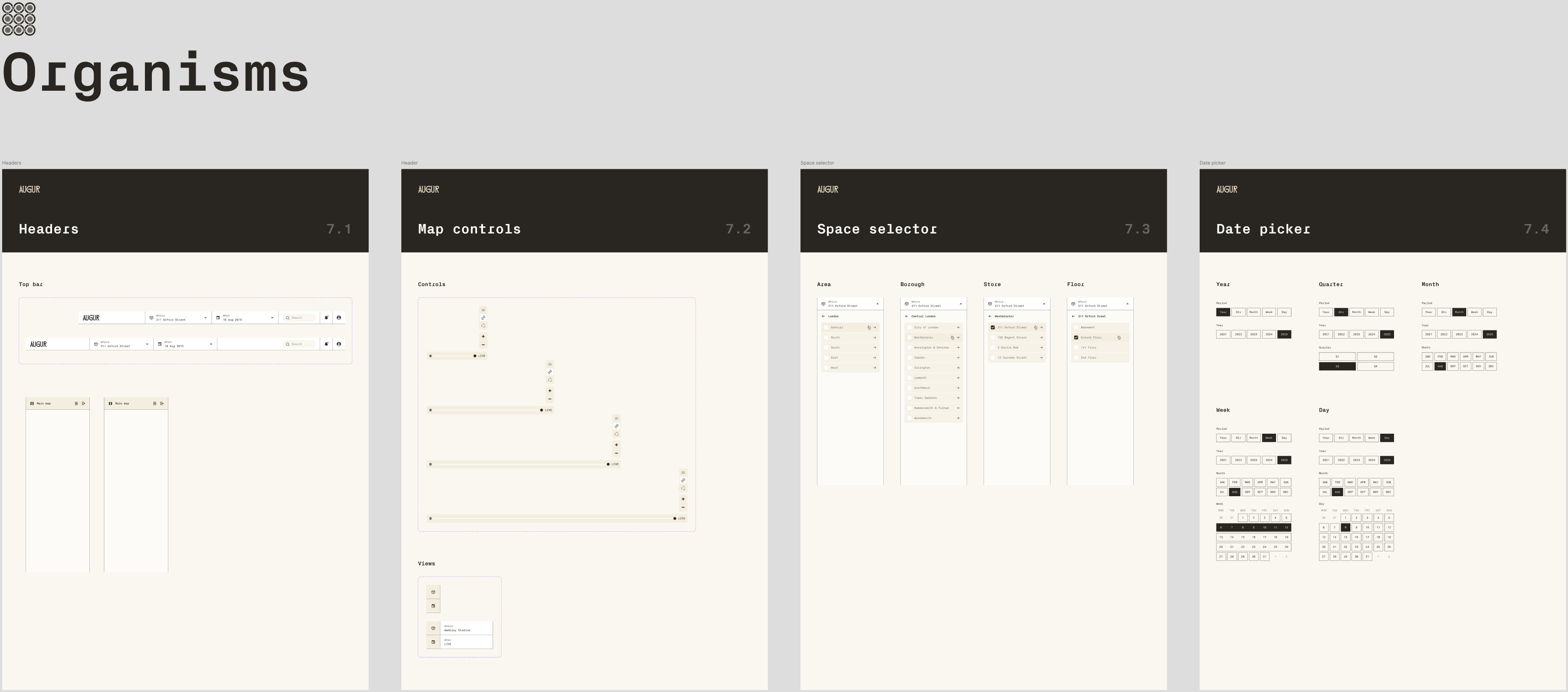
Design system
Starting from a basic brand guideline, I built a scalable design system including:
- Typography and colour foundations
- Component library (navigation, panels, data views)
- Interaction patterns for complex behaviours
The system evolved alongside the product, enabling:
- Faster iteration
- Consistency across features
- Easier collaboration with engineering


The final outcome
The result was a fully designed, demonstrable SaaS platform that:
- Makes AI-generated insights accessible and actionable
- Supports a wide range of environments:
- Commercial spaces
- Transport networks
- Enterprise and government use cases
- Bridges the gap between advanced AI capability and real-world usability


Impact

Contributed to
$15M seed funding

Helped evolve a proof of concept into a viable product

Enabled proactive, insight-driven security workflows

Positioned the company for scaling across industries
Reflection
This project reinforced the importance of:
- Clarity in complex systems
- Designing for multiple dimensions (space + time + behaviour)
- Balancing technical possibility with user understanding
- Driving product thinking at an early-stage startup level
Augur
Industry
AI powered security
Product
SaaS Platform
Overview
I joined Augur as the founding product designer, responsible for transforming an early-stage AI proof of concept into a scalable SaaS platform.
Augur applies artificial intelligence to existing CCTV infrastructure, enabling automated detection of people, events, and behavioural patterns—shifting security from reactive monitoring to proactive insight.
My role Founding Product Designer
Scope Product strategy, UX/UI design, design system
Stage Early-stage startup (pre-seed → seed)
Outcome Investor-ready product contributing to $15M seed funding
The problem
Traditional CCTV systems are fundamentally limited:
- They rely on humans to monitor and interpret footage
- Investigations require hours of manual video review
- Insights are lost when footage is deleted
- Systems are reactive, not preventative
The result: Security teams spend more time reviewing the past than preventing the future.
The opportunity
Augur’s technology could:
- Detect people, behaviours, and patterns automatically
- Surface real-time alerts and insights
- Turn static footage into searchable, queryable data
The challenge was designing a product that could make complex AI outputs usable, intuitive, and actionable.

My role
As the founding designer, I:
- Defined the product vision and UX strategy
- Translated a technical prototype into a usable SaaS platform
- Led discovery, concept exploration, and interaction design
- Worked closely with the founder and engineers
- Built the foundations of a scalable design system
Discovery & Alignment
Step 1: Rapid response
In my first week, I delivered design work to support a live client presentation, quickly getting up to speed with the product and domain.
- Step 2: Defining the problem space
- I facilitated a cross-functional workshop to align the team on:
- What we’re building and why
- Who it’s for
- What success looks like
- Risks, constraints, and opportunities
- We mapped:
- User types (security operators, analysts, business owners)
- Jobs to be done
- Potential applications across industries
Shaping the product
Insights from discovery were translated into:
- User stories
- End-to-end journeys
- Core interaction flows
This helped define a product focused on three key activities:
- Monitoring (what’s happening now?)
- Investigation (what happened?)
- Analysis (what patterns exist?)
Design exploration
I explored 7 different product directions, each tackling how users might:
- Navigate physical spaces
- Interact with time
- Understand AI-detected events
- Move between data and video
We reviewed concepts collaboratively, assessing trade-offs between:
- Simplicity vs capability
- Spatial vs list-based interfaces
- Real-time vs historical interaction models
Designing the core experience
The final product centred around a spatial + temporal interface, allowing users to explore environments across time.
Space navigation
Kings Road
Where
Select and move through physical environments
Time control
Yesterday morning
When
Scrub backward and forward through events
Entity tracking
12:48, 13/08/25
Unidentified young adult female
Floor 3, Area 2B
Identify and follow individuals across a space
Event detection
12:48, 13/08/25
Potential theft
Unidentified young adult female
Floor 3, Area 2B
View AI-triggered incidents and alerts
Pattern recognition
Surface behavioural insights over time
Multi-view environments
Switch between 2D, 3D, and immersive views
Handling complexity
One of the core challenges was balancing:
- High data density
- Real-time + historical interaction
- Multiple mental models (space, time, people, events, data)
I addressed this by:
- Structuring the UI around clear layers (space, time, people, events, data)
- Using progressive disclosure to reduce overload
- Designing intuitive controls for time and navigation
- Creating consistent interaction patterns across views
Design system
Starting from a basic brand guideline, I built a scalable design system including:
- Typography and colour foundations
- Component library (navigation, panels, data views)
- Interaction patterns for complex behaviours
The system evolved alongside the product, enabling:
- Faster iteration
- Consistency across features
- Easier collaboration with engineering


The final outcome
The result was a fully designed, demonstrable SaaS platform that:
- Makes AI-generated insights accessible and actionable
- Supports a wide range of environments:
- Commercial spaces
- Transport networks
- Enterprise and government use cases
- Bridges the gap between advanced AI capability and real-world usability
Impact
Contributed to
$15M seed funding
Helped evolve a proof of concept into a viable product
Enabled proactive, insight-driven security workflows
Positioned the company for scaling across industries
Reflection
This project reinforced the importance of:
- Clarity in complex systems
- Designing for multiple dimensions (space + time + behaviour)
- Balancing technical possibility with user understanding
- Driving product thinking at an early-stage startup level
Augur
Industry
AI powered security
Product
SaaS Platform
Overview
I joined Augur as the founding product designer, responsible for transforming an early-stage AI proof of concept into a scalable SaaS platform.
Augur applies artificial intelligence to existing CCTV infrastructure, enabling automated detection of people, events, and behavioural patterns—shifting security from reactive monitoring to proactive insight.
My role Founding Product Designer
Scope Product strategy, UX/UI design, design system
Stage Early-stage startup (pre-seed → seed)
Outcome Investor-ready product contributing to $15M seed funding
The problem
Traditional CCTV systems are fundamentally limited:
- They rely on humans to monitor and interpret footage
- Investigations require hours of manual video review
- Insights are lost when footage is deleted
- Systems are reactive, not preventative
The result: Security teams spend more time reviewing the past than preventing the future.
The opportunity
Augur’s technology could:
- Detect people, behaviours, and patterns automatically
- Surface real-time alerts and insights
- Turn static footage into searchable, queryable data
The challenge was designing a product that could make complex AI outputs usable, intuitive, and actionable.

My role
As the founding designer, I:
- Defined the product vision and UX strategy
- Translated a technical prototype into a usable SaaS platform
- Led discovery, concept exploration, and interaction design
- Worked closely with the founder and engineers
- Built the foundations of a scalable design system
Discovery & Alignment
Step 1: Rapid response
In my first week, I delivered design work to support a live client presentation, quickly getting up to speed with the product and domain.
- Step 2: Defining the problem space
- I facilitated a cross-functional workshop to align the team on:
- What we’re building and why
- Who it’s for
- What success looks like
- Risks, constraints, and opportunities
- We mapped:
- User types (security operators, analysts, business owners)
- Jobs to be done
- Potential applications across industries
Shaping the product
Insights from discovery were translated into:
- User stories
- End-to-end journeys
- Core interaction flows
This helped define a product focused on three key activities:
- Monitoring (what’s happening now?)
- Investigation (what happened?)
- Analysis (what patterns exist?)
Design exploration
I explored 7 different product directions, each tackling how users might:
- Navigate physical spaces
- Interact with time
- Understand AI-detected events
- Move between data and video
We reviewed concepts collaboratively, assessing trade-offs between:
- Simplicity vs capability
- Spatial vs list-based interfaces
- Real-time vs historical interaction models
Designing the core experience
The final product centred around a spatial + temporal interface, allowing users to explore environments across time.
Space navigation
Kings Road
Where
Select and move through physical environments
Time control
Yesterday morning
When
Scrub backward and forward through events
Entity tracking
12:48, 13/08/25
Unidentified young adult female
Floor 3, Area 2B
Identify and follow individuals across a space
Event detection
12:48, 13/08/25
Potential theft
Unidentified young adult female
Floor 3, Area 2B
View AI-triggered incidents and alerts
Pattern recognition
Surface behavioural insights over time
Multi-view environments
Switch between 2D, 3D, and immersive views
Handling complexity
One of the core challenges was balancing:
- High data density
- Real-time + historical interaction
- Multiple mental models (space, time, people, events, data)
I addressed this by:
- Structuring the UI around clear layers (space, time, people, events, data)
- Using progressive disclosure to reduce overload
- Designing intuitive controls for time and navigation
- Creating consistent interaction patterns across views
Design system
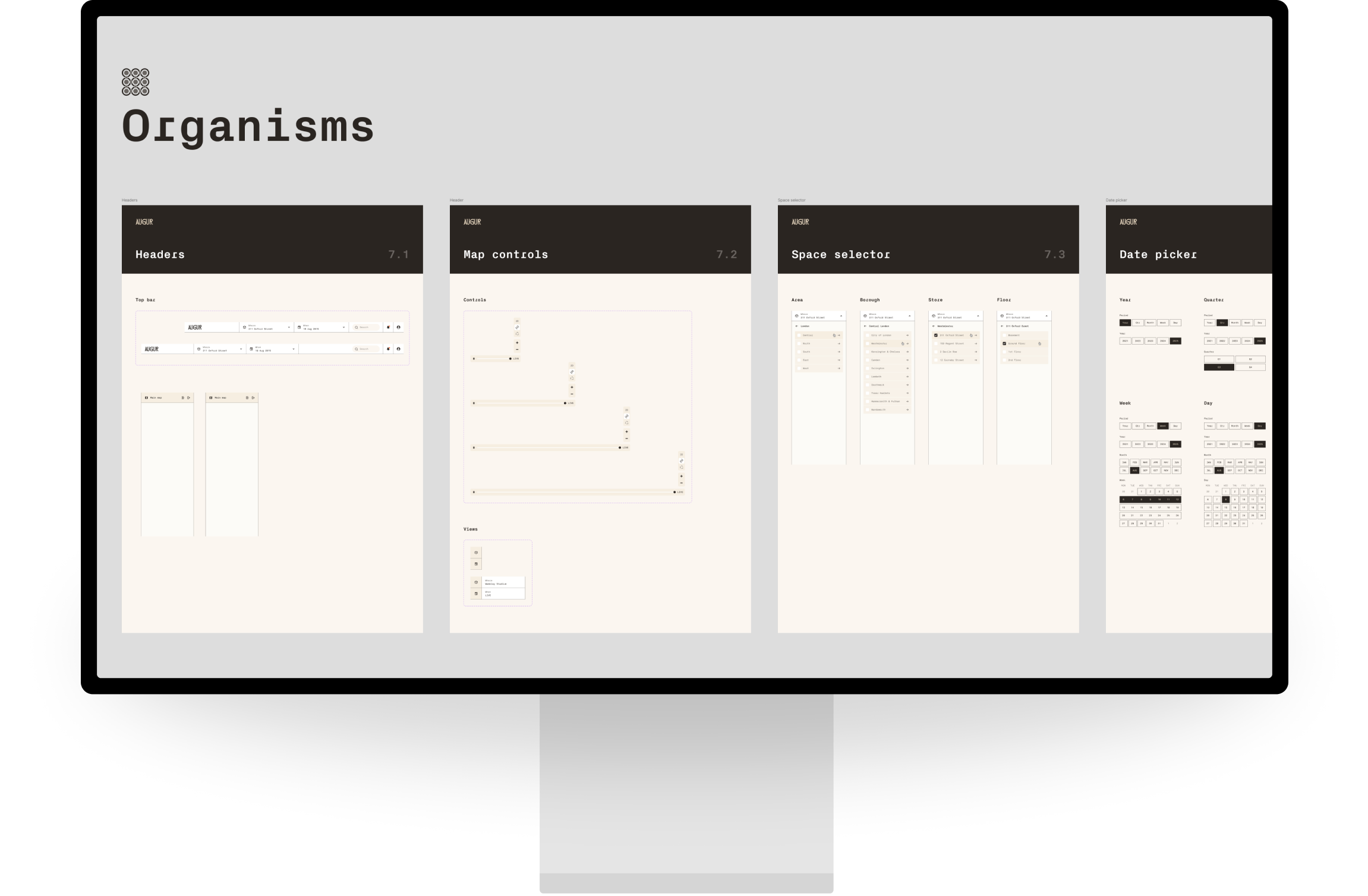
Starting from a basic brand guideline, I built a scalable design system including:
- Typography and colour foundations
- Component library (navigation, panels, data views)
- Interaction patterns for complex behaviours
The system evolved alongside the product, enabling:
- Faster iteration
- Consistency across features
- Easier collaboration with engineering
The final outcome
The result was a fully designed, demonstrable SaaS platform that:
- Makes AI-generated insights accessible and actionable
- Supports a wide range of environments:
- Commercial spaces
- Transport networks
- Enterprise and government use cases
- Bridges the gap between advanced AI capability and real-world usability
Impact
Contributed to
$15M seed funding
Helped evolve a proof of concept into a viable product

Enabled proactive, insight-driven security workflows
Positioned the company for scaling across industries
Reflection
This project reinforced the importance of:
- Clarity in complex systems
- Designing for multiple dimensions (space + time + behaviour)
- Balancing technical possibility with user understanding
- Driving product thinking at an early-stage startup level

Augur
Industry
AI powered security
Product
SaaS Platform
Overview
I joined Augur as the founding product designer, responsible for transforming an early-stage AI proof of concept into a scalable SaaS platform.
Augur applies artificial intelligence to existing CCTV infrastructure, enabling automated detection of people, events, and behavioural patterns—shifting security from reactive monitoring to proactive insight.
My role Founding Product Designer
Scope Product strategy, UX/UI design, design system
Stage Early-stage startup (pre-seed → seed)
Outcome Investor-ready product contributing to $15M seed funding
The problem
Traditional CCTV systems are fundamentally limited:
- They rely on humans to monitor and interpret footage
- Investigations require hours of manual video review
- Insights are lost when footage is deleted
- Systems are reactive, not preventative
The result: Security teams spend more time reviewing the past than preventing the future.
The opportunity
Augur’s technology could:
- Detect people, behaviours, and patterns automatically
- Surface real-time alerts and insights
- Turn static footage into searchable, queryable data
The challenge was designing a product that could make complex AI outputs usable, intuitive, and actionable.

My role
As the founding designer, I:
- Defined the product vision and UX strategy
- Translated a technical prototype into a usable SaaS platform
- Led discovery, concept exploration, and interaction design
- Worked closely with the founder and engineers
- Built the foundations of a scalable design system
Discovery & Alignment
Step 1: Rapid response
In my first week, I delivered design work to support a live client presentation, quickly getting up to speed with the product and domain.
Step 2: Defining the problem space
I facilitated a cross-functional workshop to align the team on:
- What we’re building and why
- Who it’s for
- What success looks like
- Risks, constraints, and opportunities
We mapped:
- User types (security operators, analysts, business owners)
- Jobs to be done
- Potential applications across industries
Shaping the product
Insights from discovery were translated into:
- User stories
- End-to-end journeys
- Core interaction flows
This helped define a product focused on three key activities:
- Monitoring (what’s happening now?)
- Investigation (what happened?)
- Analysis (what patterns exist?)
Design exploration
I explored 7 different product directions, each tackling how users might:
- Navigate physical spaces
- Interact with time
- Understand AI-detected events
- Move between data and video
We reviewed concepts collaboratively, assessing trade-offs between:
- Simplicity vs capability
- Spatial vs list-based interfaces
- Real-time vs historical interaction models
Designing the core experience
The final product centred around a spatial + temporal interface, allowing users to explore environments across time.
Space navigation
Kings Road
Where
Select and move through physical environments
Time control
Yesterday morning
When
Scrub backward and forward through events
Entity tracking
12:48, 13/08/25
Unidentified young adult female
Floor 3, Area 2B
Identify and follow individuals across a space
Event detection
12:48, 13/08/25
Potential theft
Unidentified young adult female
Floor 3, Area 2B
View AI-triggered incidents and alerts
Pattern recognition


Surface behavioural insights over time
Multi-view environments


Switch between 2D, 3D, and immersive views
Handling complexity
One of the core challenges was balancing:
- High data density
- Real-time + historical interaction
- Multiple mental models (space, time, people, events, data)
I addressed this by:
- Structuring the UI around clear layers (space, time, people, events, data)
- Using progressive disclosure to reduce overload
- Designing intuitive controls for time and navigation
- Creating consistent interaction patterns across views
Design system
Starting from a basic brand guideline, I built a scalable design system including:
- Typography and colour foundations
- Component library (navigation, panels, data views)
- Interaction patterns for complex behaviours
The system evolved alongside the product, enabling:
- Faster iteration
- Consistency across features
- Easier collaboration with engineering


The final outcome
The result was a fully designed, demonstrable SaaS platform that:
- Makes AI-generated insights accessible and actionable
- Supports a wide range of environments:
- Commercial spaces
- Transport networks
- Enterprise and government use cases
- Bridges the gap between advanced AI capability and real-world usability
Impact
Contributed to
$15M seed funding

Helped evolve a proof of concept into a viable product

Enabled proactive, insight-driven security workflows

Positioned the company for scaling across industries
Reflection
This project reinforced the importance of:
- Clarity in complex systems
- Designing for multiple dimensions (space + time + behaviour)
- Balancing technical possibility with user understanding
- Driving product thinking at an early-stage startup level

Augur
Industry
AI powered security
Product
SaaS Platform
Overview
I joined Augur as the founding product designer, responsible for transforming an early-stage AI proof of concept into a scalable SaaS platform.
Augur applies artificial intelligence to existing CCTV infrastructure, enabling automated detection of people, events, and behavioural patterns—shifting security from reactive monitoring to proactive insight.
My role Founding Product Designer
Scope Product strategy, UX/UI design, design system
Stage Early-stage startup (pre-seed → seed)
Outcome Investor-ready product contributing to $15M seed funding
The problem
Traditional CCTV systems are fundamentally limited:
- They rely on humans to monitor and interpret footage
- Investigations require hours of manual video review
- Insights are lost when footage is deleted
- Systems are reactive, not preventative
The result: Security teams spend more time reviewing the past than preventing the future.
The opportunity
Augur’s technology could:
- Detect people, behaviours, and patterns automatically
- Surface real-time alerts and insights
- Turn static footage into searchable, queryable data
The challenge was designing a product that could make complex AI outputs usable, intuitive, and actionable.

My role
As the founding designer, I:
- Defined the product vision and UX strategy
- Translated a technical prototype into a usable SaaS platform
- Led discovery, concept exploration, and interaction design
- Worked closely with the founder and engineers
- Built the foundations of a scalable design system
Discovery & Alignment
Step 1: Rapid response
In my first week, I delivered design work to support a live client presentation, quickly getting up to speed with the product and domain.
- Step 2: Defining the problem space
- I facilitated a cross-functional workshop to align the team on:
- What we’re building and why
- Who it’s for
- What success looks like
- Risks, constraints, and opportunities
- We mapped:
- User types (security operators, analysts, business owners)
- Jobs to be done
- Potential applications across industries
Shaping the product
Insights from discovery were translated into:
- User stories
- End-to-end journeys
- Core interaction flows
This helped define a product focused on three key activities:
- Monitoring (what’s happening now?)
- Investigation (what happened?)
- Analysis (what patterns exist?)
Design exploration
I explored 7 different product directions, each tackling how users might:
- Navigate physical spaces
- Interact with time
- Understand AI-detected events
- Move between data and video
We reviewed concepts collaboratively, assessing trade-offs between:
- Simplicity vs capability
- Spatial vs list-based interfaces
- Real-time vs historical interaction models
Designing the core experience
The final product centred around a spatial + temporal interface, allowing users to explore environments across time.
Space navigation
Kings Road
Where
Select and move through physical environments
Time control
Yesterday morning
When
Scrub backward and forward through events
Entity tracking
12:48, 13/08/25
Unidentified young adult female
Floor 3, Area 2B
Identify and follow individuals across a space
Event detection
12:48, 13/08/25
Potential theft
Unidentified young adult female
Floor 3, Area 2B
View AI-triggered incidents and alerts
Pattern recognition
Surface behavioural insights over time
Multi-view environments
Switch between 2D, 3D, and immersive views
Handling complexity
One of the core challenges was balancing:
- High data density
- Real-time + historical interaction
- Multiple mental models (space, time, people, events, data)
I addressed this by:
- Structuring the UI around clear layers (space, time, people, events, data)
- Using progressive disclosure to reduce overload
- Designing intuitive controls for time and navigation
- Creating consistent interaction patterns across views
Design system
Starting from a basic brand guideline, I built a scalable design system including:
- Typography and colour foundations
- Component library (navigation, panels, data views)
- Interaction patterns for complex behaviours
The system evolved alongside the product, enabling:
- Faster iteration
- Consistency across features
- Easier collaboration with engineering


The final outcome
The result was a fully designed, demonstrable SaaS platform that:
- Makes AI-generated insights accessible and actionable
- Supports a wide range of environments:
- Commercial spaces
- Transport networks
- Enterprise and government use cases
- Bridges the gap between advanced AI capability and real-world usability
Impact

Contributed to
$15M seed funding

Helped evolve a proof of concept into a viable product

Enabled proactive, insight-driven security workflows
Positioned the company for scaling across industries
Reflection
This project reinforced the importance of:
- Clarity in complex systems
- Designing for multiple dimensions (space + time + behaviour)
- Balancing technical possibility with user understanding
- Driving product thinking at an early-stage startup level